Model Routing vs Gateways: Breaking Down the Difference
AI gateways give you access to various models. Intelligent model routing automatically recommends the best model at the lowest cost for each request.
To scale efficiently and effectively, production AI needs both.
Routers and gateways are easy to confuse. Many products marketed as routers are simply gateways doing rules-based routing. It’s important to distinguish them however because they perform very different objectives and also require very different capabilities to build, deploy, and maintain. This guide is written to clarify the differences for engineering and platform leaders deciding what to build and what to buy in their multi-model AI stack.
What is a model gateway?
An AI gateway is the control plane for production AI traffic. It provides a unified API to many model providers, and mature gateways have grown well beyond access: the feature set now spans billing, cost controls, governance, observability, caching, security, and provider failover. No single gateway covers all of these equally well, and the category has fragmented around what each optimizes for; to dig deeper on specific solutions, you can read our guide to the Top Ten AI Gateways.
The value of a gateway is access and control. It is where an enterprise enforces who can use which model, under what policy, at what spend.
What is an AI model router?
An AI model router is a decision layer that picks which model to use for each prompt to maximize quality while minimizing cost. Most agentic workloads entail a long string of simple requests that do not need the most expensive model, and so intelligently routing simple steps to cheaper models can reduce spend if done correctly.
What does it mean to do routing correctly? First it is important to understand which model is effective on which inputs, both to avoid defaulting to the most powerful model available and to avoid incorrectly recommending weak models when they’re not up to the job. These missed recommendations can cost you even more money when they get stuck in loops or create mistakes more powerful models have to go back and fix.
Additionally, it’s important to look at how reasoning effort, KV cache state, context length, compaction, and sub-agents all impact routing economics over the long-horizon rewards of coding agents. We cover more detail on all this below.
How do you combine a router with a gateway?
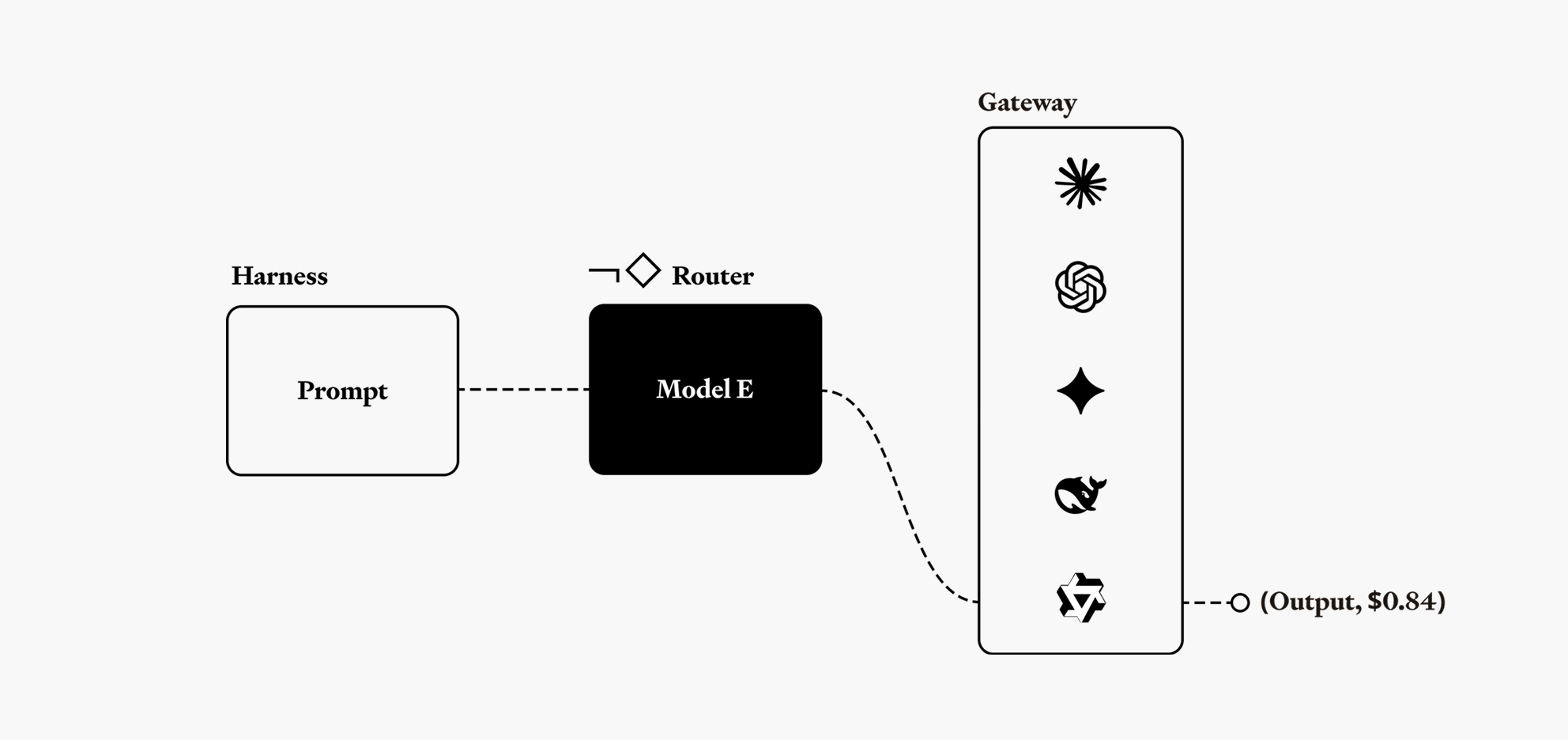
An intelligent router sits between your agent and your gateway. It determines which model and reasoning effort to use for each request and then passes this recommendation, together with the payload, to your gateway which calls the specified model.
At Not Diamond, we’ve built our model router to work with any gateway, including LiteLLM, Portkey, TrueFoundry, OpenRouter, or any other model access infrastructure. Our router returns a model recommendation for a given request which is then executed through the keys, contracts, and governance you manage in your gateway.
What's the difference between a model router and a model gateway?
A gateway governs deterministic model access while a router automatically decides which model to use.
- Model gateway: the control plane for AI traffic. It decides who can call which provider, under what policy, budget, and audit trail, working from identity, quotas, and provider availability. It optimizes for access, governance, and reliability; LiteLLM, Portkey, OpenRouter, and Cloudflare AI Gateway compete at this layer.
- Model router: the decision layer above the gateway. It decides which model handles each request, at what effort level, and with what payload, working from the content and state of the request. It optimizes for cost and quality; Not Diamond operates at this layer.
With hardly an exception, most enterprises we work with want to own their gateway infrastructure, because that is where privacy, governance, and security live. Routing on the other hand is less a pure infrastructure challenge and more of a machine learning and data challenge that has to be re-solved every month as the model landscape changes. This is why many enterprises choose to work with model routing vendors.
What does a model router base its recommendations on?
Routing is more than a complexity classifier that sorts prompts into easy and hard. In fact, this kind of naive routing can often degrade both quality and cost-efficiency by breaking cache and improperly using weak models on simple steps that have complex downstream consequences.
An effective model router weighs the model, reasoning effort, cache state, payload semantics, sub-agent architecture, and the sequence of all past recommendations against a given model pool and cost objective, and intelligently updates model recommendations as a session evolves.
What’s more, picking the model is only half of the challenge, because the same model can be invoked in ways that move cost and quality as much as the model choice. We also need to determine the reasoning effort. Higher effort spends more reasoning tokens for more latency and cost, with diminishing returns on many tasks.
On long-running sessions it is essential to weigh the KV cache policy. Switching to a cheaper model too deep in a session can break the KV cache and force a full uncached re-prefill that costs more than it saves.
For these reasons, a simple complexity classifier or rules-based router is inadequate for effective, scalable model routing.
How do you evaluate an AI model router?
An ideal model router should be evaluated on its ability to maintain frontier quality at a fraction of a cost. If we didn’t care about quality, solving cost would be easy; the challenge is achieving top quality while cutting out unnecessary spend.
At Not Diamond, we assess model routing for coding agents across three dimensions:
- Public and internal benchmarks
- Developer experience
- Developer productivity
These points are critical as the objective of model routing is to increase ROI. We can’t optimize I if we don’t understand R.
Frequently asked questions
Is an intelligent model router the same as an AI gateway?
A gateway is an access and control layer covering API normalization, auth, governance, observability, and failover. An intelligent model router is a decision layer that picks which model handles each request and how. Most products marketed as routers are gateways doing deterministic, rules-based routing.
Do I need both a gateway and a router?
Yes. A gateway provides access and governance, and a router provides per-request cost and quality optimization. They solve different problems.
Does a router replace my gateway or my governance?
A router does not replace your gateway. A router sits in front of your gateway, and requests are executed through your existing infrastructure and contracts.
Is routing already a feature of my gateway?
Many gateways offer deterministic routing for reliability: static rules, fallbacks, and load balancing. A dedicated AI model router adds content-aware, per-request model selection optimized for cost and quality.
Can I build routing into my gateway myself?
Model routing is a difficult problem which spans research, data science, engineering, and infrastructure. Additionally, maintaining a model routing solution requires tracking many moving targets as the model and agent landscape continuously evolves. This is why we believe it makes sense to work with a model routing vendor. If you want to build routing yourself, we recommend investing in a strong research and engineering team who is prepared to continuously update the solution over time.